
Understanding Hard Hat Lifespan, Certification and Replacement on Construction Sites
Back to blogUnderstanding Hard Hat Lifespan, Certification and Replacement on Construction Sites
Hard hats sound straightforward until someone on site asks whether the helmets in the store are still safe to issue, whether an old one can be kept as a spare, or whether the date stamped inside means manufacture date, expiry date or something else entirely.
For procurement teams, site managers and health and safety leads, head protection is one of those everyday PPE categories that can easily become too familiar.
It gets ordered regularly, handed out quickly and worn across almost every live site. Yet the details still matter, because a hard hat is not just a standard site item. It is a piece of protective equipment with a limited working life, specific certification requirements and real performance expectations.
Getting it right helps protect workers, reduce replacement confusion and make sure the right PPE reaches site first time.

Quick Reference Guide
The Common Misconception Around Hard Hats
One of the most common misconceptions is that a hard hat is fine as long as it still looks roughly intact.
In reality, the condition of a hard hat is not always obvious at a glance. A helmet may have no major cracks or dents, but still be affected by age, UV exposure, damaged suspension, poor storage or a previous impact.
This is where procurement and site control become important.
It is not enough to know that hard hats have been supplied. Teams need to know what has been supplied, when it was issued, whether it is suitable for the job, and whether it is still fit for purpose.
A hard hat is designed to reduce the risk of head injury from hazards such as falling objects, flying debris and accidental contact with fixed structures. Its effectiveness depends on the shell and the internal harness working together. If either part is compromised, the level of protection may be reduced.
What Does the Date Inside a Hard Hat Mean?
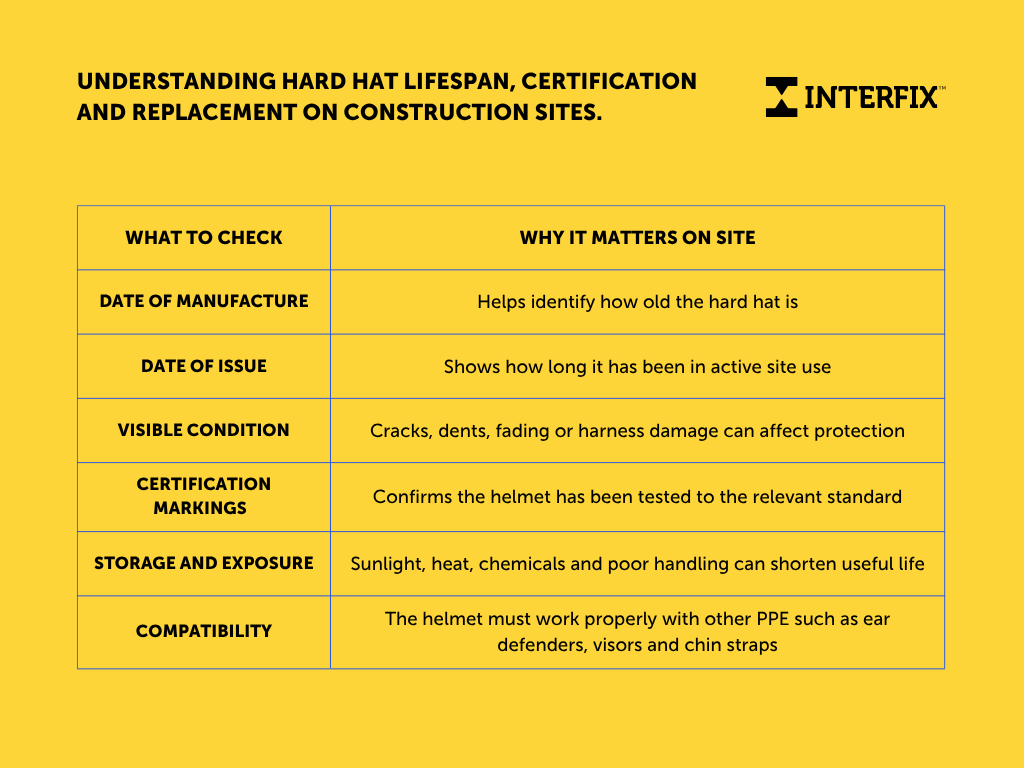
Most hard hats include a date stamp inside the shell. This is usually the date of manufacture, rather than the date the helmet was first used on site.
That distinction matters.
A hard hat may have been manufactured several months before it arrived with the supplier, then held in stock before being issued to a worker. This does not automatically make it unsuitable, but it does mean procurement teams and site managers should not rely on guesswork.
The best approach is to check the manufacturer’s guidance for the specific helmet being supplied and record the date of issue when it is handed over.
This gives site teams a clearer audit trail and makes replacement planning much easier. Without that process, old helmets can sit in vans, cabins and storage areas for years. They may then be handed out again because they appear unused, even though no one is certain how old they are or how they have been stored.
What Takes Its Toll on a Hard Hat?
Construction sites are tough environments, and hard hats are exposed to more than obvious impacts.
Sunlight is one of the biggest factors. Extended UV exposure can gradually affect the plastic shell, especially when helmets are worn outdoors for long periods or stored in direct sunlight. A hard hat left on a dashboard, in the back of a van or outside a site cabin can age faster than one stored correctly.
Daily wear also matters.
Helmets are often dropped, knocked, scraped, stacked, clipped to bags, stored with tools or exposed to dust and moisture. Individually, these things may seem minor. Over time, they can affect the shell, the harness or the way the helmet fits.
Chemical exposure is another consideration. Paints, solvents, adhesives and cleaning products can affect certain helmet materials. This is particularly important when hard hats are marked, decorated or cleaned without checking the manufacturer’s instructions.
If a hard hat has taken a significant knock, it should not simply be put back into circulation because there is no visible crack. Some damage may not be easy to see, particularly if the internal structure or harness has been affected.
On site, the safest culture is the clearest one: when in doubt, remove it from use and replace it.
Certification: What Procurement Teams Should Check
Hard hats should be certified to the relevant standard for industrial head protection. In most construction environments, buyers will commonly be looking for helmets that meet BS EN 397 or the appropriate equivalent standard stated in the product information.
This is where clear specification matters.
A product listing should make it obvious what standard the helmet meets, what optional performance features it includes and whether it is suitable for the intended working environment.
Procurement teams should also check whether the helmet is compatible with other PPE used on site. For example, a helmet may need to work with ear defenders, eye protection, face protection or a chin strap. If the fit is poor or the accessories do not work correctly together, site teams may end up adjusting or removing PPE during the working day.
That creates a practical safety problem.
The right hard hat is not simply the cheapest compliant option. It needs to be suitable, comfortable, compatible and easy for teams to wear correctly throughout the day.
When Should a Hard Hat Be Replaced?
There is no single answer that applies to every helmet in every site environment, because replacement periods depend on manufacturer guidance, usage, exposure and condition.
However, there are clear situations where replacement should be considered immediately.
A hard hat should be taken out of use if it is cracked, dented, brittle, badly faded, heavily scratched, misshapen or damaged in any way that could affect performance. The same applies if the internal harness is broken, loose, worn or no longer holds securely.
It should also be replaced if it has sustained a meaningful impact, even if the damage is not visible.
For site teams, this is where the inspection routine needs to be simple enough to use. Workers should know what to look for before wearing a helmet. Supervisors should know when to remove items from use. Procurement teams should have enough replacement stock available so damaged PPE is not kept in circulation because there is no immediate alternative.
Good stock control supports good safety behaviour.
The Procurement Risk No One Talks About Enough
Hard hats are low-cost compared with many site supplies, but poor control can still create unnecessary cost.
If teams do not know what is in stock, replacement becomes reactive. If old helmets are mixed with new helmets, it becomes harder to know what can safely be issued. If products are ordered from different sources without consistent specification, sites can end up with different helmet types, different fittings and different replacement guidance.
This creates friction.
Site managers then have to make judgement calls. Health and safety teams have to chase missing information. Procurement teams have to deal with urgent orders that could have been planned earlier.
A better approach is to treat head protection as part of a managed PPE category.
That means keeping product choice consistent where possible, recording issue dates, checking stock condition and making replacement easy. It also means working with suppliers who understand site realities and can support regular supply without unnecessary admin.
Final Thought
Hard hats are one of the most familiar items on a construction site, which is exactly why they can be taken for granted.
A small check can prevent old, damaged or unsuitable head protection from staying in use. A better ordering process can reduce last-minute PPE issues. A clearer specification can help buyers avoid confusion between similar products.
For construction procurement teams, this is about more than buying another box of hard hats.
It is about getting the right product to site, keeping workers properly protected and reducing the admin that comes from uncertainty.
Before a hard hat is issued, worn or returned to storage, it is worth asking one simple question.
How old is it, and is it still fit for the job?
Interfix can support construction teams with practical PPE supply, helping sites stay stocked, organised and ready for the working day.
Interfix. Greater control. Less admin. Zero hassle.
